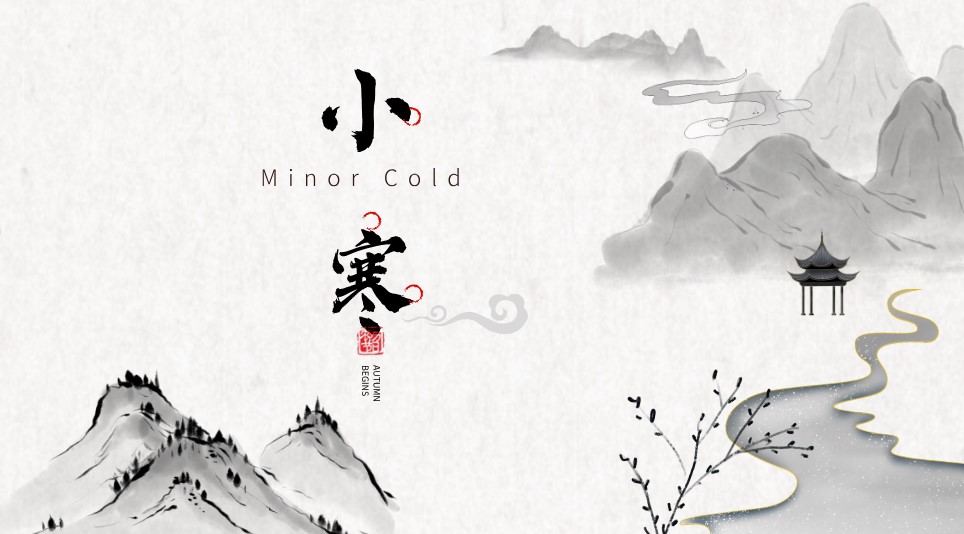
Minor Cold, the 23rd solar term in the traditional Chinese lunar calendar and the fifth solar term of winter, marks the official beginning of the winter season.
When the sun reaches 285 degrees of the ecliptic (Minor Cold), it signifies the arrival of the coldest days of the year across the Chinese mainland. According to Chinese meteorological data, Minor Cold is the solar term with the lowest average temperatures, with only a few years seeing higher temperatures during Dahan (the following solar term). By Minor Cold, the heat stored deep within the soil has dissipated to its lowest point. Although daylight hours lengthen slightly and the sun's light and warmth increase marginally, this period actually sees the greatest imbalance between heat loss and gain, making it the coldest time of the year. The “Nine Nines” counting of cold days, which begins at the Winter Solstice, designates the “Third Nine” as the coldest period, which invariably falls within the Minor Cold solar term. By Minor Cold, the north is gripped by bitter frost where water freezes instantly, while most southern regions endure biting frost and snow that chills to the bone. For farming activities, northerners can focus on composting manure and constructing water conservancy projects, while southerners must ensure proper winter irrigation and apply soil mounding with fertilizer to help crops survive the cold season.
Minor Cold is the coldest time of winter in China, a period for reinforcing health with warm foods and exercise as the cold intensifies.
 IPv6 network supported
 English
 русский
 español
 português